@smallwheels , I am not sure how long you have been around with Xenforo. But you have to acknowledge what we have here today is not what this place used to be. Small team or not, Xenforo years ago was much more active staff and community. Especially during the XF 1.0 years. It never used to feel like it was just up to one developer to keep the ship sailing, even if it’s not a enterprise company - I don’t see why after all these years it now feels like we’ve taken steps backwards to now be dependent on one developer (Chris), especially now that we know he has personal family emergencies going on.
If we look at Wikipedia XF 1.0 was released in March 2011 and 1.1 was released in Nov 2011:
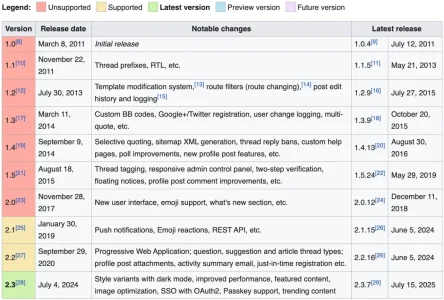
So you are basically talking about a timespan of six months 15 years ago and make this the reference of how things used to be and how they still should be now. This is a bit like daydreaming of your teenage years when you are 60 and realizing that your life is not like it was back then but ignoring the fact that times have changed, you have changed, the world has changed and there is no rollback button. And than be unhappy about that and expect everything should be as it was back then. With an attitude like that you can only become unhappy and negative if not destructive.
Back then XF was new, the company and the product, all routes were open, staff was energetic (and much younger than today) and the customers were ecstatic about the new product. The team needed urgently the input of and conversations with customers and was able and willing to follow it as it helped them and any possible route was equally easy to follow (more or less) apart from the fact that with a new product a lot of features and routes are an obvious choice as you are working on a green field.
Yet already 2013 there was a thread on this forum that (probably not accidently) has a very similar topic and very similar content to this one - you can find it below under the similar threads that the search recommends:

I wasn't a customer of XF back then but clearly XF1.0 must have lacked a lot in comparison to XF 2.3.7 as we know it today. Obviously, over time the route got more difficult: The ways to go became less obvious, and each choice came along with a price: No longer green field but more and more brown field. If you have a look at the
announcement of XF2.0 , which was released in Nov 2017, nine years and two months ago, you will find the following:
XenForo 2.0 is a major update from version 1. It includes many new features and significant changes under the hood, with the core code having been completely redesigned.
This is not uncommon. From my experience any given online platform has to do this more or less regularly, most have a lifespan between five and 12 years before such a complete overhaul has to happen - it seems unavoidable: Staff has learned, technology changes, customer expectations change, new feature ideas are born and technical decisions and implementations that were done earlier can not reflect that. In other words: I you'd have to decide today about what you decided years ago you'd often make a different decision or take a different route (which you couldn't do back then as you didn't know what you know today plus today's technology wasn't available anyway). Often or mostly the issue is ignored for a couple of years and the result is what we call technical debt: Your implementations live on credit as they are not technically sound and one day you have to pay back the credit with interest and to rewrite the whole thing. Depending from what amount of credit you accumulated over the years the interest may be higher or lower and you pay the interest with everything you implement by getting slowed down with your development as the age of the stack, the old decisions, architecture and implementations break you considerably and more intensive the longer you delay the payback. In the worst case until barely any progress is possible any more and than latest it is payback time. For the full credit plus a huge amount of leftover interest in the worst case.
Then latest it is time for a dangerous decision: Full rewrite or continuous refactoring of smaller parts over what is considered to be a longer period of time. The rewrite sounds attractive: Finally green field again and so no technical constraints, no legacy code, a lot of fun and sure we will do everything right this time, finally. The price to pay is that you have limited resources and therefor your product development comes to full stop during the rewrite. But this is only for a relatively short amount of time, as you assume naively. However: The bigger, the older and the more complex your product is the longer a rewrite will take. Still it seems an attractive solution - to the innocent. Probably every software company and ever team have hit this trap at least once but reality shows: About 95% pf full rewrites fail dramatically: They typically take years longer than expected, do not at all deliver what was hoped for or simply do fail completely and are never finished. Therefor experienced teams typically take the longer route: continuous refactoring and rewrites in small chunks within the existing old legacy code. The problem with this approach is: Less fun, the torture never stops and you have to care continuously that the chunk you bite off is small enough that you can deal with it yet big enough to allow i.e. relevant architectural changes and this in a way that it can be changed easily again when it comes to the next round in a couple of years. Obviously this is not easy but it is easy to get lost in refactoring - which may be fun for developers but creates unhappy customers as from their perspective absolutely nothing happens. Which is true on the one hand (as in the end you have the same featurese as before when you are done) but untrue on the other (as you hopefully stabilize the whole thing and create the fundament to develop faster in future.
Given what
@Chris D has communicated about 2.4 and 3.0 in the past XF are exactly in this situation of being in the need for a more or less massive structural overhaul to improve for the future. Which would also fit the age of the product, becoming 15 years since the first release and nine since a core rewrite for 2.0 in 2017. Also, they clearly (and thankfully) decided to go for the less attractive but more successful route of refactoring instead of full rewrite. As outlined before the effort and time needed and the constraints and challenges to overcome are typically dramatically underestimated plus it is easy to get lost by taking a wrong turn or, as he phrased it, the "scenic route" (which later often turns out being not so scenic at all but very long). No doubt this has happened to XF as for one it is unavoidable to a degree and secondly it is obvious given the dramatically missed timeframes they set themselves and communicated. to the customers. The bad luck the team faced on a personal leveis therefor just the ice on the cake.
What we see as customers are the typical effects of such an undertaking: Barely visible progress, barely new features, massively reduced communication, no need for input - and embarassed silence from the team whenever they missed a timeframe again. It may not be nice but is's normal and if you are familiar with these kind of projects you see the signs. They are renovating the structures of the house, hidden in the cellar. So you don't see them, the house doesn't get painted and it makes no sense to demand a new swimming pool in the garden as they are busy and have no capacity and neither need nor time nor desire to discuss those kind of things as what they do needs their full attention and there is no customer input needed as customers couldn't deliver relevant input and it is even w/o them hard enough to make the right decisions and bring them to life successfully in a halfway foreseeable timeframe.
While in a bigger company there might be a dedicated person available for jumping around customers, making jokes and caring for the mood of the audience in a company as small as XenForo there is no such dedicated person. Each hour spent with customers or for communication stretches the refactoring work for another day as you loose focus and have to find it again. At least that's how it feels. Yet somewhat frequent communication is necessary and well invested time, even if it may be hard and embarrassing, costs a price in form of further delays. Has been often learned the hard way and if there is something to learn for XF from the last months it is probably exactly that: Good and timely honest communication cannot be overestimated and it worth whatever it costs.
To come back to the start: XF has outgrown it's teenage years and they won't come back. As every adult has to face the challenges of adulthood including complex constraints and having to live with the consequences of decisions made years ago as well having a little less energy and desire for nightshifts the same goes for XenForo, the XF team members - but also for the customers. They have grown older as well, their lifes have changes as well and they made decisions as well in the past that they are responsible for and they have to live with. And their teenage years won't come back as well while adulthood, reality and aging are sometimes hard and desillusional.
It is in my eyes absolutely fair to demand responsible behavior and regular communication from XenForo, to hold them accountable and maybe even helpful to call them back down to earth from time to time from whatever scenic route they may have taken at any given moment in time. It would however be as unfair as unrealistic to expect from the XF team to act like in 2011 when product and company were new and everyone including the customers were 15 years younger. It would be counterproductive to expect constant and instant anwers to whatever comes to someones mind and simply idiotic to insist on things that never have been promised or said or are obviously outdated or a misunderstanding. Or to expect things that XF can simply not deliver due to obvious lack of manpower or a clear strategic decision. As customers we have to understand and to accept where XF is standing right now, what challenges they are facing and what the consequences of both are. XF can foster that by communication - yet customers should stay away from completely unrealistic expectations as this is not a dream world but reality, as sad as this may be sometimes.