XF Internal Linker V2 - The Vibe Coding journey begins!

Update: I have noticed the observability stack, like GlitchTip, SonarQube, Pyroscope, Faro, Tempo, Loki, isn't quite enterprise-grade for what I'm trying to do. But still, that's the good about computer science. You go on and test ideas and continue testing your hypotheses until the science marinates itself, and you start to feel like you are the final boss.

Right now, I'm building a Deterministic Code Validation Engine for AI-Assisted Vibe Coding. To prove it works, I’m putting together a crucible experiment.

The setup is to use a local development XenForo monolith with a hell tonne of bugs. I’m making custom-made mutations and reverse-engineering them so that they survive a prolonged test. These aren't simple syntax errors; they are deep, stealthy logic flaws and state corruptions. I want to see if my scanner can spot these issues in sub-milliseconds.

The Architectural Realization:

Initially, I was thinking about dropping down to C or doing a Rust/C hybrid to get bare-metal speed for the low-level stuff. But I quickly realized that if my engine actually tries to run the mutated XenForo code to test it, I will never hit sub-milliseconds. Bootstrapping a massive PHP monolith, establishing local TCP connections to MySQL, and dealing with kernel context switches physically takes 10 to 50 milliseconds minimum. You simply cannot dynamically execute stateful web code faster than the speed of network sockets and standard I/O.

To beat physics and catch these "survivor" bugs instantly, I skipped C entirely. I'm going 100% bare-metal Rust and cheating standard I/O bottlenecks by analyzing the code purely in-memory as mathematical data before it hits a runtime.

The "Final Boss" Architecture:

1. Hot RAM AST Graphs:

I'm using tree-sitter natively in Rust to parse the entire XenForo dev into an Abstract Syntax Tree (AST). I am keeping that massive graph piping hot in active RAM. Zero disk reads during validation.

2. Delta Scanning:

When I inject a mutation (or when an AI generates new code), the engine does not rescan the monolith. It purely parses the code diff and dynamically patches the AST entirely in memory.

3. Deterministic Taint Tracking:

Since my survivor bugs are complex and usually involve passing bad data through multiple files (like an altered variable in a Controller quietly corrupting a DB Model later), the Rust engine traverses the memory graph to track the data flow. Because this happens strictly inside Rust's memory and the CPU's L3 cache, I can mathematically flag the payload in roughly 200–500 microseconds.

The Ultimate Benchmark:

This is how I'll know the science has fully marinated. I’m going to use that standard observability stack I mentioned earlier as my baseline control group.

I’ll let XenForo run normally with the injected bug, and let GlitchTip, Loki, and Tempo do their thing—taking 2.5 seconds to hit the network stack, gather traces, and report the crash.

Then, I'll feed that same mutation diff into my Rust engine and watch the terminal light up red, tracing the taint and rejecting the untrusted code with mathematical certainty in ~0.4 milliseconds -- before the PHP server even has time to finish booting.

Curious if anyone else here is messing around with keeping massive monolithic ASTs hot in RAM for real-time AI code validation, or if you're still relying on dynamic sandboxing?
 
Update: I learned something new. Forcing code documentation.

Not sure if this is good or how long it will take. Anyway, will come back with vibe coding results. I will one-shot this (deviating from the modus operandi); it's just docs. Let's see how smart Gemini 3.1 Pro is.

CRITICAL RULE: Documentation Policy (docs.localhost)

1. Hard Block on Commit: Whenever you (the agent) or a developer make code edits to the application, you MUST simultaneously update the relevant documentation. If code modifications are made without corresponding documentation updates, you must HARD-BLOCK and reject the commit.

2. Comprehensive Coverage: The documentation must serve as the single source of truth and exhaustively cover exactly everything the application does. No undocumented features.

3. Framework & UI/UX: The documentation must be built using Docusaurus. Maintain a clean, intuitive, and strictly organized structure. Absolutely no sprawling or "spaghetti" UI/UX layouts.

4. Design Tokens: The Docusaurus site must be styled using accurate Apple HIG design tokens with a modern glassmorphism aesthetic, no backround weirdness, use a modern react stack, ask me questions about it, perfectly matching the modern Apple liquid glass color palettes used by standard text editors.
 
Improved AutoIssues.


Markdown (GitHub flavored):
# Inter-Model AutoIssue Interface

## Summary

Build a SQLite-backed coordination tool for the keyphrase **“solve autoissues”**. It does not launch agents. It lets whichever agents you manually activate join the same pool, wait 2 minutes for teammates, claim non-overlapping AutoIssues/files, sprint toward 30 fixes, cross-review, reach consensus, and recommend one agent for final staging/commit.

## Key Changes

- Add a Python entrypoint: `scripts/solve_autoissues.py`.
- Add shared coordination logic, likely in `scripts/inter_model_interface.py`.
- Store live state in ignored runtime files under `audit/inter_model/`.
- Use SQLite tables for:
  - active waves and 2-minute join gates
  - agent registrations and heartbeats
  - issue claims, file/folder locks, sprint status
  - review notes, correction requests, consensus votes
  - final commit-agent recommendation
- Add commands:
  - `python scripts/solve_autoissues.py join --agent codex|claude|gemini|antigravity`
  - `python scripts/solve_autoissues.py status`
  - `python scripts/solve_autoissues.py claim-next`
  - `python scripts/solve_autoissues.py mark-fixed --issue <id>`
  - `python scripts/solve_autoissues.py review --issue <id> --vote pass|needs-correction`
  - `python scripts/solve_autoissues.py recommend-commit-agent`

## Behavior

- Given the first agent types **“solve autoissues”**, when it joins the pool, then it waits 2 minutes before claiming work.
- Given another agent joins during that 2-minute gate, when the gate closes, then both agents work as the sprint team.
- Given an agent joins after the gate closes, when a sprint is active, then it waits for the next sprint instead of disrupting current claims.
- Given two issues touch the same file or folder, when claims are assigned, then only one active agent can own that area at a time.
- Given 30 issues are fixed, when the sprint ends, then agents enter a 15-minute cross-review window.
- Given cross-review passes, when consensus is reached, then the tool recommends one final commit agent but does not commit.

## TDD And Tests

- Add unit tests first for:
  - database schema creation
  - 2-minute join gate membership
  - no auto-spawn behavior
  - non-overlapping file/folder claims
  - stale heartbeat cleanup
  - late agent waits for next sprint
  - review/correction/consensus flow
  - commit-agent recommendation logic
- Run the focused test red first, implement the smallest passing code, then rerun green.
- After building, run the full unit test file again.
- Use Dell/turbo where the repo supports it; if no repo-owned turbo path supports these pure Python script tests, record `turbo=blocked:<plain reason>` and run the smallest local unit test as diagnostic proof.

## Assumptions

- The keyphrase is implemented as a repo command that agents know to run; it does not need chat-app integration.
- SQLite is the source of truth for coordination.
- No branches, no commits, no staging unless the user gives the final commit signal.
- Runtime SQLite files and logs are ignored and not committed.
 
Today I learned about ELCV! Yay.

ELCV is a tool that measures how much real, unique, working logic your code contains; a size/quality number that can't be faked by padding lines, copy-pasting, or auto-generating filler. It works by reading the code's structure (its "AST"; the parsed shape of the code) and computing three things:
  • LEU: counts the real decision points (ifs, loops, branches). Comments/blank lines/boilerplate = 0.
  • USO: counts unique operations; identical logic copied around collapses to a single operation.
  • SCW: a 0.5–1.0 multiplier that penalizes over-complex code so convoluted code can't inflate the number.
  • Final: ELCV = (LEU × SCW) + USO.
What you get from it: an honest size number, a per-area breakdown, and a quality signal that rewards real distinct logic and punishes duplication + complexity.
 
Also going to improve AutoIssues to have features like Google's Bugaziner, 1/4 of Google's Bazel is done, Claude is now writing over 3k slices, yep, individual 3k slices written in BDD style for test cases/edge cases/specs researched from academic papers and patents; implementation done with tdd/kiss/dry/unit tests/pbt/mutations to reach 5 million lines of code for Aegis.

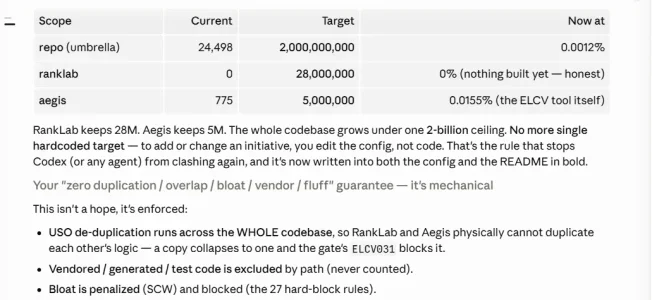
Still not done, me and my buddies Claude and Codex we are going to be billionaires - not in the monetary sense as such for now, but me and my buddies Claude/Codex we will reach a super mega 1 billion ELCV! That means no junk, no bloat, no duplication, no garbage code; it gets blocked upon commit. Aegis, with its 5m muscles, will act as a bouncer, slapping Claude and Codex until they fall in line.

1 billion here we go, folks... As earlier on, I said, I will always come back with the result and keep you posted. I will, yes, I will. Speaking of which, just upgraded Angular to version 22, gonna make our own custom components, super excited. Changed my mind about making Xenforo headless. I will focus on the offline app, because it's a money-printing machine 😂, well, faith is a good thing.
 

Attachments

  • Screenshot (970).webp
    Screenshot (970).webp
    54.7 KB · Views: 29
My buddy Claude and I, we will build the Atlas internal linking app, 2 billion LOC. Powered by ELCV, though. Yay!

Will take months; that's fine. See you soon.
 
Claude came in clutch, and vibe coding dreams are shaping up 😁 :

Here is my revised test suite setup with no AI agents anywhere in it.


Layer 1 — Commit (under 30 seconds, local):
Format, lint, and type checking run first — Python via ruff + mypy strict, Rust via rustfmt + clippy, TypeScript via prettier + eslint strict. Then scoped coverage on files you actually touched: 98% line, 98% branch, 100% function. Then three fast static checks on the staged diff only: secret detection, language-specific security scanners (bandit / cargo-audit / eslint-security), and complexity limits (≤10 cyclomatic, ≤50-line functions, ≤1500-line files).

Layer 2 — Push (under 10 minutes, Dell via Google's Bazel):
Full test suite across all three languages, including property-based tests and Playwright E2E. Mutation testing scoped to changed files at 95% kill rate — mutmut for Python, cargo-mutants for Rust, Stryker for TypeScript. Architecture checks: import-linter for modular monolith boundaries, circular dependency detection, cargo-deny for Rust crate supply chain. Plus the regression blocker: if a file in your diff has an open critical or high AutoIssue already filed, push is hard-blocked until you resolve it.

Layer 3 — Nightly (automated tools, async, never blocks commit or push directly):
Five parallel automated tool domains covering the full checklist — security (semgrep + full-tree audits), correctness (concurrency + transaction + TZ rules), performance and data (N+1 + index + cache + OOM), architecture (duplication + dead code + coupling), and tests and observability (flaky tests + coverage gaps + logging gaps). Every finding goes to AutoIssues with root cause, exact fix, and a regression test so the next agent picking it up has a clear starting point.

Layer 4 — Deferred hard block:
Critical findings get 48 hours before they start blocking pushes that touch the affected file. High findings get 7 days. Medium and low go through the normal AutoIssue quota at commit time — no hard block, but they appear in every session start payload.
 
My app is now shaping up. I have over 4 thousand prompts waiting that will produce over 50 million lines of code, I kinda scared of the complexity. Every day, things are getting complex. Testing, things breaking, fixing bugs for over 12 hours - now imagine with 50m LOC; that's bigger than the Linux kernel itself. Most of it is Rust.

One may ask why it is getting that big? Well, because some of those 4 thousand prompts include algorithms that Claude uses to take over Windows, open up MATLAB/Wolfram, and do extensive research with both plus Jupyter. Then write code based on that research, test it with Jupyter and the Wolfram engine till it passes, then back and forth. Plus a full-blown analytics engine that will rival Adobe Analytics. Anyway, will always come back with more stats, pinky promise. The journey is exciting. The good thing is that XenForo is state-of-the-art forum software, so crawling it is easy and stripping boilerplate is child's play. Nonetheless, see you soon on another day.


1782237515497.webp


1782237542374.webp


1782237554186.webp
 
I read a research paper and found out that Google has a massive and seriously advanced complex system they call Borg.

Borg is also used to power their internal infrastructure projects. It is also used for other GCP stuff. I found that interesting.

So me being curious, I am going to implement parts of it that I like, and parts of Cloud Run/App Runner. I am going to put it to the test with PCs that have low specs.

This should perhaps give me a rough idea of what to heavily optimize rather than using much capable hardware. If it can run on low PC specs, then that's good. That's exactly what I want, not for it to be a resource hog.

Mine will be called PsyBorg. The name is catchy, and I like it. 😍

Ideally, you would want to build this with Rust or C. But my vision now is to migrate to Spring Boot. Which is what I am doing right now. The problem is that Django, being Python first, has cool AI/ML stuff compared to Java. But it's another post for another day. I am done with polyglot stuff; it's hard to keep up with, that's why Spring Boot has entered the chat, and we are starting from scratch. Interesting times ahead.

So why PsyBorg and Spring Boot? Well, PsyBorg will allow Claude to build the app with granular control, and without drifting, hallucinating, and having to guess about performance issues and constraints, there is no maybe, if or how do I do this?

PsyBorg assumes you are writing apps for it, but Kubernetes doesn't. PsyBorg will be heavily opinionated; it will be more than a container management system. It will be the spine of the app itself. That way, everything will be noob friendly, nice dashboard, you just push buttons.

PsyBorg will do some cool stuff, such as, but not limited to:

Parallel execution and testing
  • Distributed integration testing that shards the test suite across all three machines simultaneously to divide the total test time.
  • Test container offloading that ensures database dependencies run on a separate machine from the process actively running the tests.
  • Parallel execution of partitioned batch jobs by dividing the data grid across the Dell, Mint, and Acer nodes at the same time.
  • Cross-machine event republication handling that automatically retries failed module events on a healthy machine if the original node goes offline.
  • Automatic compilation caching is distributed across the homelab to skip rebuilding code that has not changed.
  • Single-command build, and test pipelines parallelized across the cluster to replicate a high-end continuous integration environment.
  • Background task yielding that automatically pauses low-priority batch partitions when user-facing web requests suddenly spike.
  • Direct memory access optimizations for inter-process communication when separate modules are scheduled onto the same hardware.
Network and state management
  • Transparent reverse proxying using a highly optimized Nginx configuration managed directly by PsyBorg.
  • Zero-downtime rolling updates that migrate application modules one machine at a time without dropping active user connections.
  • Localized caching that utilizes the spare memory of the Mint machine as an ephemeral cache for the entire cluster.
  • Log aggregation is built on simple file tailing and socket streaming instead of deploying a massive indexing stack.
  • Automated ShedLock configuration injection to prevent distributed scheduling conflicts across the three nodes without manual setup.
  • Predictable static address mapping for inter-module communication to bypass the memory overhead of a dedicated domain name system server.
  • Request shadowing that duplicates live traffic to a secondary machine for safe, isolated testing of new application versions.
  • Automatic garbage collection tuning is injected into the application based on the specific hardware constraints of the host machine.
  • Scale-to-zero database connection pooling that proactively drops idle network connections when specific application modules go to sleep.
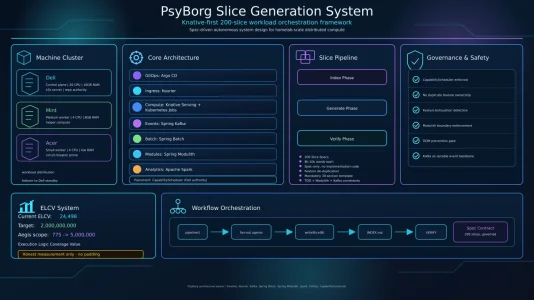
I will vibe code PsyBorg carefully, nice and slow, (doing tests and everything) using SDD, Spec Driven Development, and come back with results. The estimate is about 5-8 million lines of code, but we will do it in 200 slices, i.e., 200 markdown files for the foundation stuff, then scale to one thousand.

I use slices because PsyBorg is too big to design safely as one huge plan. If I try to describe the whole system in one place, the work becomes blurry, duplicated, and easy to exaggerate. A slice (minimum 8k words, max 10k words) gives me a controlled piece of the system that I can explain, review, verify, and eventually turn into an implementation without losing track of what it owns.

Each slice is basically one specification unit. It tells me what a part of PsyBorg is for, why it exists, what it is allowed to control, and what it must not touch. Some slices define the project rules, like product identity, non-goals, source of truth, ELCV honesty, duplication control, and governance. Other slices define the platform, like Knative, Kourier, Argo CD, GitOps workflow, service templates, traffic policy, and homelab constraints.

The reason I want slices is to stop the system from becoming a pile of impressive but unverified ideas. Every slice forces a clear boundary. If two slices try to own the same feature, that duplication can be caught. If a slice is vague, padded, or not measurable, it can be rejected. If a slice ignores the real machines, like Dell, Mint, and Acer, it can be corrected before code gets written.

In simple terms, the slices do the planning, boundary-setting, and verification work before implementation begins. They are not the finished app, and they are not supposed to be random notes. They are the blueprint pieces that explain what PsyBorg should become, one controlled part at a time.

Below is the test slice generation system and the test cluster. Low PC specs for the cluster are okay; that's how I will know if it is optimized or not. If it can run on that, it should run on any PCs.

ChatGPT Image Jun 29, 2026, 12_23_29 PM.webp
 

Attachments

  • psyborg-infographic-4k-landscape.webp
    psyborg-infographic-4k-landscape.webp
    61 KB · Views: 21
Just created something useful, an infographic, except my PsyBorg is going to have one cell as a starting point.

Below is a rough idea of how Google's Borg works.

google-borg-infographic-4k.webp


FeatureWhat PsyBorg needsInspiration
App-aware service modelFirst-class App, Service, Worker, Batch, Cron, and AI Job, not just containersPsyBorg opinionated layer
Job and task modelA job can have many repeatable tasks with indexes, status, logs, and resource needsBorg
Cell modelGroup your low-spec PCs into a “cell” so PsyBorg schedules across Dell/Acer/Mint as one poolBorg
Node agentLightweight agent on every PC to start, stop, monitor, and report workloadsBorglet
Central controllerSpring Boot control plane that stores desired state and makes scheduling decisionsBorgmaster
Declarative app specYAML/JSON/GUI form that describes app, resources, ports, health, scaling, and dependenciesBorg BCL / Cloud Run
GUI-first service creation“Create service” wizard for Spring Boot apps, APIs, workers, and batch jobsApp Runner
Source-to-service deployPush from Git/source folder and let PsyBorg build/run itApp Runner / Cloud Run
Container image deployRun a prebuilt image when source build is not wantedApp Runner / Cloud Run
Build profilesJava/Spring Boot buildpacks, Maven/Gradle detection, JVM tuning profilesSpring Boot direction
Immutable revisionsEvery deploy creates a revision that can be rolled backCloud Run
Traffic splittingSend 1%, 10%, 50%, 100% traffic to a new revisionCloud Run
One-click rollbackRestore previous revision from GUICloud Run
Canary deploysSlowly test new revisions while watching health and latencyCloud Run
Blue-green deploysKeep old and new versions side by side, then switch trafficCloud Run
Scale to zeroStop idle services to save RAM/CPU on weak PCsCloud Run
Minimum instancesKeep important services warm to avoid cold startsCloud Run
Manual scalingLet user pin exact instance counts for fragile low-spec setupsCloud Run
Concurrency limitsCap requests per instance so Spring Boot services do not overloadCloud Run
CPU/memory limitsHard limits per service/taskBorg / Cloud Run
Fine-grained resource requestsAvoid fixed “small/medium/large” buckets; allow exact CPU/RAM/disk needsBorg
Resource reservationsReserve expected usage separately from maximum limitBorg
Resource reclamationLet batch/background jobs use unused reserved capacityBorg
Low-spec modePresets for 4-16 GB RAM machines, slower disks, laptop CPUs, and no GPUPsyBorg
Admission controlReject or delay work that cannot safely fitBorg
Priority bandsMonitoring, production, worker, batch, best-effortBorg
QuotasPer-project/user CPU, RAM, disk, and runtime budgetsBorg
PreemptionHigher-priority work can evict lower-priority workBorg
Graceful terminationSend shutdown notice before killing a serviceBorg / Cloud Run SIGTERM idea
Pending explanationGUI tells user exactly why something cannot runBorg “why pending?”
Scheduling hints“Reduce RAM to 512 MB” or “move to Acer node” style guidanceBorg
Hard constraintsMust run on Linux Mint, must have GPU, must have SSD, must have port XBorg
Soft constraintsPrefer Dell, prefer SSD, prefer low CPU temperature, prefer same node as DBBorg
Anti-affinitySpread replicas across different PCs to avoid one-machine failureBorg
Failure domainsModel machine, room, power source, OS, disk type, and network pathBorg
Package/image cachePrefer nodes that already have the needed build/image/dependenciesBorg
Parallel package distributionCopy builds/images to nodes efficientlyBorg
Fast startup trackingMeasure build time, image pull time, JVM boot time, health-ready timeBorg
Health checksHTTP/TCP/process health checks with restart policyBorg / Cloud Run
Readiness checksOnly route traffic after app is readyCloud Run/Kubernetes style
Liveness checksRestart stuck services automaticallyBorg
Stable service namingInternal names like api.project.cell.psyborg.localBorg name service
Dynamic service discoveryUpdate endpoints when tasks moveBorg / Cloud Run services
Built-in load balancingRoute traffic across healthy replicasCloud Run/App Runner
Custom domainsMap local or public domains to servicesApp Runner / Cloud Run
Secrets managerStore API keys, DB passwords, model keys safelyCloud Run/App Runner style
Environment managerGUI-managed env vars per service/revisionCloud Run/App Runner
Config versioningTrack config changes separately from code changesBorg / Cloud Run
Log collectionPer-service logs, rotated to avoid filling diskBorg
Metrics collectionCPU, RAM, disk, network, request rate, latency, errors, JVM statsBorg
Spring Actuator ingestionPull health, metrics, env, beans, mappings, startup, cache, and thread infoSpring Boot
Event timelineSubmit, build, deploy, schedule, start, fail, restart, kill, updateBorg
Drill-down dashboardCell -> node -> service -> task -> logs/metrics/eventsBorg Sigma UI
“Why slow?” panelExplain CPU throttle, RAM pressure, GC pause, disk wait, cold startPsyBorg
JVM tuning advisorRecommend heap, GC, virtual threads, lazy init, CDS, native image when usefulSpring Boot
Offline simulatorTest “will this fit?” before deploying to real PCsBorg Fauxmaster
CheckpointsSnapshot control-plane state for recovery and simulationBorg
Replay debuggerReplay scheduler decisions and failures after something breaksBorg
Capacity plannerEstimate how many services your current PCs can runBorg
Compaction testSimulate running the same workload on fewer resources to find wasteBorg
Auto-repackingMove tasks around to reduce fragmentation and free a whole machineBorg
Batch schedulerRun heavy jobs only when spare resources existBorg
Cron/periodic jobsBuilt-in scheduled jobs from GUIBorg ecosystem
Workflow jobsMulti-step pipelines: build, ingest, index, evaluate, deployBorg ecosystem
App templatesSpring API, Spring worker, Kafka consumer, batch job, ML inference servicePsyBorg
Kafka-aware workersScale consumers by lag, partitions, and processing timeYour current stack
AI agent guardrailsClaude gets exact controls, resource facts, pending reasons, and approved actionsPsyBorg goal
Change approval gatesRequire human approval for risky deploys, preemptions, or quota changesPsyBorg
Noob-safe presetsSimple modes: cheap, fast, safe, batch-only, productionPsyBorg
Policy engineEnforce “don’t deploy if tests fail,” “don’t exceed RAM,” “don’t mix embeddings”PsyBorg
Auto-issuesConvert failures, bad configs, slow services, and resource waste into actionable issuesYour autoissues idea
Self-test suiteStress, failover, cold start, memory pressure, and scheduling tests under 15 minutesLow-spec validation
 
Ah yes.

At its core, this is a human-reviewed internal-link recommendation project for XenForo forums, with optional WordPress support.

It...
  1. Reads forum/blog content without modifying it.
  2. Finds related pages and identifies a natural sentence and anchor phrase for a link.
  3. Ranks the strongest suggestions using topical similarity, existing link structure, and search-performance data.
  4. Presents suggestions for a human to approve, reject, and manually apply.
  5. Measures whether applied links improve navigation and search visibility.
The key boundary is that it never automatically edits the live XenForo or WordPress site. Analytics, PageRank, topic modelling, dashboards, and background jobs all support that central “discover → recommend → review → apply” loop.

The project is currently being rebuilt around a Java/Spring backend and React/TypeScript interface, so some repository areas represent migration work rather than the finished product.
 
My vision is clear:
Ranking weights are a versioned “recipe” for combining many evidence signals: not a few fixed knobs. They cover meaning/keyword match, page and graph authority, link freshness, phrase and field relevance, anchors, structural distance, behaviour data, and quality/risk signals.
Meta-algorithms change how results are generated and arranged, rather than merely adding a score: retrieval fusion, normalization, clustering/near-duplicate suppression, explore–exploit feedback reranking, graph candidate generation, and MMR-style diversity.
Autotuning is intended to refine weights and safe algorithm parameters from reviewer decisions and search/engagement outcomes. It must use bounded, cited settings; produce an auditable challenger; pass movement, safety, and rollback checks; and explain every change. It tunes the ranking policy: not live forum content.

Have over 7000 prompts to go through, will always come back with results, pinky promise, as said earlier.

I have four designs of the autotuner, and I will scope them so that they don't duplicate or conflict.

DesignWhereStatusHow it works
L-BFGS tunerGit repo, FR-018Built, liveMonthly gradient descent on GA4/Matomo/GSC + reviewer data, ±0.05 bounds, auto-promotes at ≥5% predicted lift, auto-rolls-back if clicks drop >15%/14 days
RankBoostGit repo, FR-061Spec'd, not builtAdaBoost-style on pairwise preferences, floor weight 0.01
AutoBrainRankLab 28 million lines of code, CORE-0027Plan only — 0 of ~7,000 prompts builtWeekly coordinate descent, deliberately not ML, ±0.02 nudges, human approval for anything risky
Online IPS learningAegis "Product Engine Cluster" (prompts 7900+)Plan onlyEvery accept/reject you make nudges weights in real time, debiased, behind an 8-guardrail safety layer (bound limits, drift detection, circuit-breaker, even a formal stability proof)
 
The good thing is that my main worry was code duplication, reinventing the wheel, testing, QA, fixing bugs, and stuff.

But what I have learned is that you can use Claude on a dev machine to control JetBrains IntelliJ (most of the project is Spring Boot, java and strict Typescript; other languages I have experimented with are banned i.e., C++, Rust, Haskell, Python, etc), meaning Claude will test every single line of code, debug what needs to be debugged, and make Claude actually use the app itself. Also, Codex can do the same, so for two reviewers it is better than one, kinda boring to watch, but as a vibe coder, what can you do? Well, I watch Netflix, chill a bit, but until then, I'm currently updating prompts till we reach a mega 7k that will produce 28 million LOC.

One would wonder if 28 million lines of code are necessary. Well, there is a lot more mathematics than I anticipated, but the way it's designed is that Claude calls them ELCV, which is explained below:


ELCV.webp


Screenshot (1026).webp


28m LOC.webp
 
Last edited:
Back
Top Bottom