"Si tacuisses, philosophus mansisses."
Sounds rich coming from you guys who wanna gatekeep technology as though it's in your basement!

"Si tacuisses, philosophus mansisses."
Well, it's very easy for you then, isn't it? Just come up with Claude's best guess and make us speechless.
No one bullied you, ffs.

Claude isn't smart, neither is any other LLM. They're just very good at guessing.

Skill issue: a vibe coder can just be as brilliant as a seasoned professional or even more efficient!
maybe efficient in the sense it saves time, but as folks pointed out in another thread - there's a lot of bugs and security holes in addons being made by AI.
I would personally ban them from the forum or have a very strict addon inspection process by the owners here, because one vulnerability by a poorly coded addon, especially with AI, could wreck havoc on someone's project.
I did a few plugins for WP with GPT and it was a complete mess. Not only did it constantly make mistakes and shut an entire website down, but it followed up with bad fixes. It may get things to a functional state, but that doesn't mean it's safe to use, so proceed with a LOT of caution here.
I hate what the internet has become tbh…
I hate what the internet has become tbh…
True, I ain't got the vibes. So use your skills and keep guessing around. People like you contribute to my job security. So master your skills and vibe on and on!SKILL ISSUE. You ain't got the vibes.
True, I ain't got the vibes. So use your skills and keep guessing around. People like you contribute to my job security. So master your skills and vibe on and on!

I agree. But think about the dystopia this AI stuff is going to create in the next 50 years. Every piece of content eventually is going to be 90% AI generated, and it’s just really depressing to me. I don’t enjoy talking to or reading messages from bots when I am online.to be fair, smart phones and social media were pretty much the worst inventions.
the internet peaked at myspace and AOL... getting us online, all day on the phones, from anywhere was just baddddddd.
I agree. But think about the dystopia this AI stuff is going to create in the next 50 years. Every piece of content eventually is going to be 90% AI generated, and it’s just really depressing to me. I don’t enjoy talking to or reading messages from bots when I am online.
you're 100% right. everything produced by AI will be lifeless garbage never worth reading.

**Core Shape**
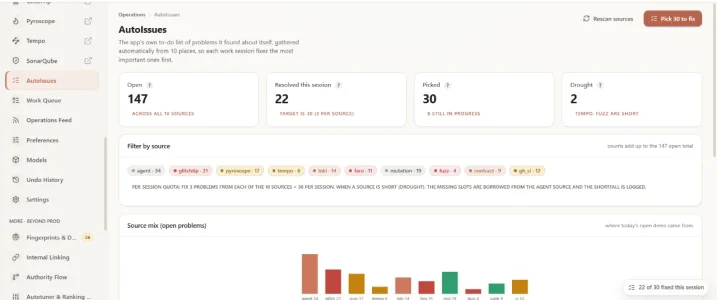
AutoIssues uses Django, which is the Python backend framework. The central table is `AutoIssue` in [models.py]. It stores `source`, `external_id`, `fingerprint`, `canonical_fingerprint`, `title`, `description`, `affected_files`, `severity`, `status`, `priority_score`, and `lessons_learned`.

The architecture uses Python as the control layer. Python reads tools, validates inputs, writes database rows, and runs commit checks. Faster compiled code handles heavy math or strict decision logic.

**Python Commands**
The command layer sits in `backend/apps/auto_issues/management/commands`.

Important commands:

- `print_open_issues`: reads open rows, groups them by source, sorts by `priority_score`, and prints the session-start marker.
- `file_hook_finding`: creates or updates one `source="agent"` AutoIssue when a hook finds a problem.
- `file_mutation_survivors`: reads mutation-test reports. Mutation testing means a tool changes code on purpose and checks whether tests catch it. Survivors become `source="mutation"` AutoIssues.
- `resolve_autoissue`: closes rows only when the agent supplies `Trap:` and `Fix shape:` lessons.
- `verify_autoissue_quota`: proves the session fixed the required issue count before commit.
- `cluster_autoissues`: reads open issues, creates feature hashes, calls the clustering service, and writes proposed cluster assignments only when `--apply` is used.

**Deduping**
`services/fingerprinting.py` creates a canonical fingerprint. That means a stable short hash for the same root problem across sources. `services/dedup.py` uses that hash to update one row instead of creating repeats. It stores source repeats in `source_observations`.

**C++ Stuff**
Python imports these modules through `pybind11`, which is the bridge that exposes C++ functions as Python modules.

Relevant native modules:

- `scoring.cpp`: batch score math.
- `papertrail_dedup.cpp`: MinHash plus locality-sensitive hashing. MinHash estimates text overlap; locality-sensitive hashing finds likely matches without comparing every pair.
- `lesson_index.cpp`: fast in-memory indexes for lesson lookup and cached proof data.
- `counting_bloom.cpp` / `compressed_bloom.cpp`: Bloom filters, which quickly answer “have we probably seen this before?”
- `count_min_sketch.cpp`: compact counting for repeated things.

The “C++ daily AutoIssue picker” is not live code yet. Its spec says C++ should eventually parse heavy profile data, score candidates, select the top issues, then return results to Python.

**Haskell Stuff**
Cabal, the Haskell build tool, defines two executables:

- `findbugs-haskell`: reads facts and outputs confirmed bug findings.
- `findbugs-cluster`: reads graph edges and groups related issues.

`FindBugs.Clustering` uses union-find, which groups connected nodes efficiently. It takes issue-pair similarities, applies a threshold, and returns clusters. Haskell owns the strict decision logic: “which items belong together?” Python owns database writes.

**Quality / AutoIssue Bridge**
`scripts/turbo_mutation.py` runs mutation tools for Python, C++, Go, Rust, TypeScript, and Haskell. It spreads eligible compiled-language work across helper machines, collects reports, then calls `manage.py file_mutation_survivors`. That turns weak-test findings into real AutoIssues.The plan should have slices; each slice should be self-contained to make it easy to copy and paste when vibe coding with LLMs, so that these things can be built in a clean, meticulous manner. Each slice must have a goal, clear boundaries, an ADR, a PRD, expected files to be created or modified, requirements, specs (patents or academic papers), test cases written in BDD style, edge cases, reusable libraries or new libraries for speed and quality to look out for, memory management, CPU management, disk management, parallel processing, and helper pcs support. The implementation stage should use TDD, KISS, and DRY, while adhering to what the specs say and addressing the test cases and edge cases. Unit tests must be conducted, along with static analysis and linting. Finally, every slice should end with a mandatory code review. With these questions answered and solved -- does the code match the specs; are errors handled properly? No spaghetti code, no verbose, useless, overengineered code. Slices should be comprehensive, and there should be dozens of them covering everything from start to finish, leaving no stone unturned and no room for error.
We use essential cookies to make this site work, and optional cookies to enhance your experience.