Perhaps if there were some concise guide to using Cloudflare that didn't require a technical degree to understand and there weren't 94 pages of often conflicting information and advice to wade through that mere mortals could comprehend I might consider it but thanks for the suggestion
Cloudflare won't catch everything, but it (or a similar service, or server process like Anubis) should be a first line of defense against the bots. It's not wise to have all that traffic hit our servers, especially since this add-on and XenForo itself run via the PHP interpreter, which adds more overhead to serving files across the Internet.
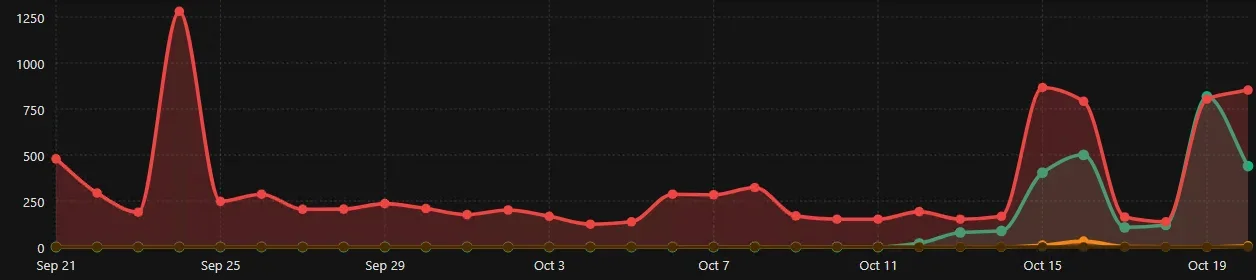
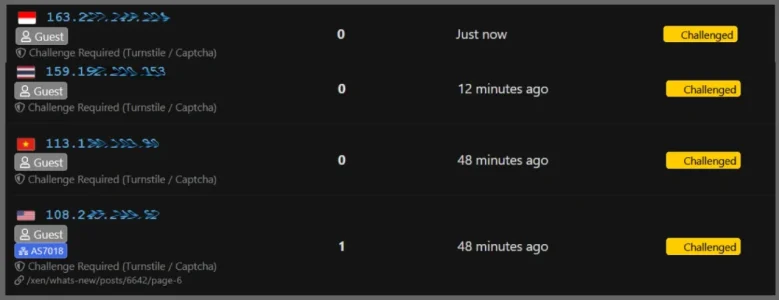
Even with basic rules, CF can take care of the worst of the traffic, which eases the load presented to our servers, and add-ons like this one (which I'll be getting for one of the forums I'm upgrading in the next couple of months) then don't have to work so hard to help get rid of the remainder of the bots. I'd rather have a large bot swarm
mostly mitigated by CF, but then let this add-on tackle the remainder, which can still be a subtantial number of bots. CF mitigates traffic the server itself will never see.
Server protection should be multi-layered, in other words.
In my case, our server firewall has closed off almost everything to the public Internet, and all 80/443 traffic (http "web" traffic) ports through CF, whose servers are the only ones allowed access to ports 80 and 443. CF filters out a lot of the garbage, but I don't have it so restrictive that
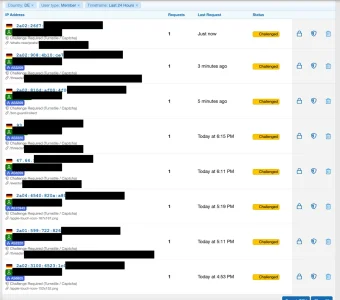
all traffic gets congested. There is still enough getting through that we can use IP Threat Monitor as the last line of defense.
The thread is a mess, I agree, but since the bot traffic changes so often, and different bots swarm all of our sites differently, by nature of that the thread has grown large because there are so many different issues all of us are trying to solve. If anything, I'd recommend looking at some of
@Anthony Parsons recent rules that take care of browser impersonations as a starting point, as well as first whitelisting those elements you don't want affected (like the xf_user cookie, your own IP address so you're not locked out, allowed search engine scrapers, etc.).
CF lets you start out with an "expression builder" that eases you into how the language works and then, once you're used to it, you can start making your own more advanced rules as needed. And any of us are willing to help if you ever need it.

(If a dense idiot like myself can figure it out...
anyone can.

)
While I prefer CF for keeping the bad traffic from hitting our physical server, if I had to do away with CF, I would use Anubis on the server. Or, I'd probably set up Anubis on a small proxy server of our own to filter the incoming traffic, so the load doesn't take away from CPU cycles for Apache, PHP, etc. (as well as Elasticsearch and MySQL if hosted on the same server). I'd never assume even Anubis could get rid of everything, which is why I'd use IP Threat Monitor as a safety net beyond that.